





Application-to-Person (A2P) messaging for businesses in Switzerland
A2P messaging stands for Application-to-Person messaging and refers to the automated sending of messages from business systems to individuals. eCall Business Messaging from F24 Schweiz AG offers Swiss businesses a secure platform for A2P messaging via SMS, WhatsApp Business API, RCS, Push (Threema), and voice for OTPs, 2FA, appointment reminders, status updates, alerts, and customer notifications.
Your benefits with A2P messaging
Automatisierte Kundenkommunikation ist heute ein zentraler Bestandteil digitaler Geschäftsprozesse. Mit Application-to-Person Messaging, kurz A2P Messaging, versenden Unternehmen wichtige Nachrichten automatisiert aus Anwendungen, Plattformen, CRM-Systemen oder APIs direkt an Kundinnen, Kunden, Mitarbeitende oder Geschäftspartner.
Whether OTP SMS for secure logins, SMS appointment reminders, delivery notifications, service alerts, WhatsApp Business API messages or RCS messaging: A2P Messaging ensures that relevant information reaches recipients quickly, reliably and through the right channel.
- Automated customer communication via SMS, WhatsApp, RCS, Push, voice, and other channels
- Wide reach for transactional messages, notifications, OTPs, and 2FA
- Swiss hosting, ISO/IEC 27001:2022, and GDPR/nDSG-compliant communication
- Centralized messaging platform with API, web portal, and integration options
- Personalized support from Switzerland for SMEs and larger companies

Why A2P Messaging Is Important for Modern Businesses
Today’s customers expect fast, clear and reliable information. They want to know when an appointment is scheduled, whether a payment has been received, when a delivery will arrive, or whether a login is truly secure. At the same time, companies need to automate processes, reduce operational costs, meet security requirements and remain reachable across multiple communication channels.
This is exactly where Application-to-Person (A2P) Messaging comes in. A2P Messaging connects business systems with professional messaging channels such as SMS, WhatsApp Business API, RCS, voice and push notifications. It enables companies to send messages not manually, but automatically, scalably and transparently.
A2P Messaging is particularly relevant for Swiss companies because customer communication must be not only fast, but also secure, data protection-compliant and trustworthy. With a professional messaging platform in Switzerland, companies can efficiently implement transactional SMS, OTP SMS, appointment reminders, status updates, alerts and opt-in marketing communications.
What is Application-to-Person Messaging?
Application-to-Person Messaging, or A2P Messaging for short, refers to the automated sending of messages from an application, software platform or business system to an individual.
Unlike private messages exchanged between two people, A2P Messaging is used by companies to send large or process-driven message volumes reliably. Typical examples include login codes, appointment reminders, order confirmations, delivery updates, security alerts and service notifications.
Put simply: A2P Messaging means that an application automatically sends a relevant message to a person.
Examples
A2P messaging is therefore a key component of automated, secure, and cross-channel customer communication.


How does A2P messaging work?
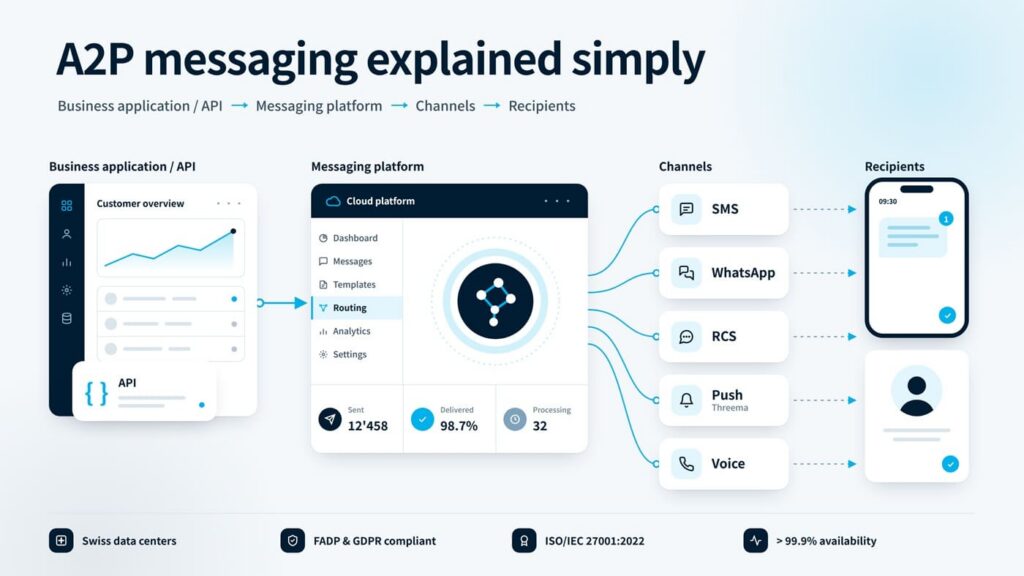
A2P messaging connects business systems with professional messaging channels. Messages are typically sent automatically via an API, a web portal, an integration, or a connected platform.
Typical workflow
Application / CRM / Platform / API → Messaging platform → Mobile network or messaging channel → Recipient
Here’s how A2P messaging works in detail:
- An event is triggered
in a system— or example, an order, a login attempt, an appointment booking, a payment, or a status change. - The enterprise system generates a message
. The message may contain personalized content, such as a name, appointment time, order number, or security code. - The message is transmitted
via an enterprise SMS API, an SMS gateway, a CPaaS platform, or a messaging integration. The messaging platform processes the message, checks delivery options, and forwards it via the appropriate channel. - The recipient receives the message
. Depending on the use case, delivery occurs via SMS, WhatsApp Business API, RCS, voice, push notifications, or other channels. - Reporting and status information are returned
. Depending on the channel, businesses can analyze delivery status, error messages, reactions, or replies.
This creates an automated communication chain that accelerates business processes and reduces manual work.
A2P vs. P2P Messaging: What’s the Difference?
A2P and P2P messaging differ primarily in terms of the sender, the purpose, and scalability.
| Criterion | A2P Messaging | P2P Messaging |
|---|---|---|
| Meaning | Application-to-Person Messaging | Person-to-Person Messaging |
| Purpose | Automated messages from companies to individuals | Private communication between two individuals |
| Sender | Application, CRM, platform, API, company | Individual |
| Recipient | Customers, Employees, Users, Partners | Another person |
| Scalability | Customers, employees, users, partners | Intended for individual personal messages |
| Automation | Highly automatable via API, web portal, or integration | Typically manual |
| Typical examples | OTP SMS, 2FA, appointment reminders, shipping status updates, alerts, opt-in marketing | Typically manual |
| Relevance for businesses | Very high for customer communication, security, service, and processes | Low, as it is not designed for professional mass or process communication |
In a nutshell
- P2P messaging is private communication between individuals.
- A2P messaging is professional, automated business communication from systems to individuals.
A2P messaging is relevant for businesses because it makes recurring messaging processes secure, scalable, and measurable.
The most important A2P messaging channels
A2P messaging is not limited to SMS. Modern companies use multiple channels to reach their target audiences depending on the use case, urgency, and customer expectations.

SMS
SMS is one of the most important A2P messaging channels. It works on virtually every cell phone, requires no app, and is particularly well-suited for time-sensitive or security-related messages.
Typical use cases:
- OTP SMS
- Two-factor authentication via SMS
- Appointment reminders via SMS
- Shipping and delivery status
- Service disruption notifications
- Payment Confirmations
- Emergency and alert communications
SMS is particularly valuable for businesses when wide reach, fast delivery, and ease of use are critical.

WhatsApp Business API
The WhatsApp Business API Switzerland is ideal for professional customer communication via WhatsApp. Businesses can use it to send service notifications, engage in conversations, send reminders, provide updates, or conduct marketing communications with a valid opt-in.
Typical use cases:
- Customer service notifications
- Appointment confirmations
- Shipping updates
- Support conversations
- Follow-ups and status updates
- WhatsApp Newsletter with Opt-in
- Automated customer communication via templates and workflows
The WhatsApp Business API is particularly relevant for companies that want to communicate where customers are already active.
RCS Messaging
RCS, short for Rich Communication Services, extends traditional SMS with modern features such as images, buttons, branding, interactive elements, and improved user experiences on supported devices.
Typical use cases:
- Interactive notifications
- Marketing campaigns
- Service updates with a call to action
- Product information
- Appointment or booking confirmations
- Rich Messaging for Mobile Customer Experiences
RCS, as a rich messaging channel, is particularly well-suited for companies that want to combine SMS reach with modern, visual communication formats.

Voice
Voice messaging enables automated voice calls or text-to-speech messages. This channel is particularly relevant when information needs to be reliably delivered even without a smartphone app or the ability to read.
Typical use cases:
- Alerts
- Emergency notifications
- Service disruption notifications
- Escalation processes
- Reminders
- Availability during critical events
Voice is particularly well-suited for time-sensitive scenarios in which a message must be actively acknowledged.

Push Notifications and Other Channels
Push notifications, messengers, in-app messages, or other digital channels can complement A2P messaging. It is crucial that companies do not focus on a single channel but rather orchestrate their communication to suit the specific use case.
A modern messaging platform enables companies to centrally manage various channels and select the appropriate communication channel depending on the situation.
Typical use cases for A2P messaging
A2P messaging supports companies in many areas: security, customer service, marketing, operations, logistics, appointment management, and digital platform processes.
OTP and Two-Factor Authentication
One particularly important use case is sending OTP SMS messages and security codes for two-factor authentication via SMS.
Companies use A2P SMS to provide additional security for login processes, transactions, password changes, or account activations. The code is generated automatically and sent to the user via SMS or another suitable channel.
Typical examples:
- Login code for a customer portal
- Transaction confirmation
- Password reset
- Account activation
- Security check for suspicious activity
- Phone number verification
A2P messaging is essential for 2FA SMS for businesses and OTPs because security messages must be delivered quickly, reliably, and with traceability.
Appointment Reminders
Appointment reminders via SMS, WhatsApp, or RCS help businesses reduce no-shows and plan resources more effectively.
Typical use cases:
- Doctor’s appointments
- Consultations
- Service calls
- Workshop appointments
- Appointments with government agencies and administrative offices
- Beauty, fitness, and health services
- Training and continuing education
Automated appointment reminders via SMS allow booking systems, calendars, CRM, or industry-specific solutions to connect directly to the messaging platform.
Shipping and Delivery Status
In retail, e-commerce, logistics, and service organizations, customers expect transparent status updates.
Typical messages:
- Order received
- Package has been shipped
- Delivery will take place today
- Ready for pickup
- Delivery attempt failed
- New delivery time available
- Return status
A2P messaging reduces customer service inquiries and improves the customer experience by proactively delivering relevant information.
Payment and booking confirmations
After making a booking, payment, or order, customers want reassurance. A2P messaging enables automatic confirmations immediately after the transaction.
Typical examples:
- Payment confirmation
- Booking confirmation
- Reservation Confirmation
- Contract confirmation
- Invoice notice
- Subscription Activation
- Ticket or Access Information
Messages like these build trust and reduce uncertainty in the customer journey.
Alerts and Service Disruption Notifications
A2P messaging is also suitable for time-sensitive communication with employees, customers, partners, or response teams.
Typical use cases:
- IT outages
- System failures
- Maintenance windows
- Security alerts
- Production issues
- Emergency communication
- Escalation processes
- On-call and standby services
Especially in critical situations, delivery quality, availability, and clear escalation paths are crucial.
Customer Service Notifications
A2P Messaging supports customer service with automated status updates and proactive communication.
Typical messages:
- Ticket created
- Request is being processed
- Response required
- Case resolved
- Support appointment confirmed
- Service visit scheduled
- Submit document
Automated customer service notifications reduce manual effort while keeping customers better informed.
Marketing campaigns with opt-in
A2P messaging can also be used for marketing communications, provided there is a valid opt-in and opt-out processes are properly implemented.
Typical use cases:
- SMS marketing
- WhatsApp newsletters
- Promotions and coupons
- Event invitations
- New Products
- Customer Loyalty Programs
- Reactivation campaigns
- Personalized Offers
It is important that marketing messages are legally sound, relevant, and tailored to the specific channel, and that they are delivered proactively.
Onboarding and Activation Messages
Digital platforms, SaaS providers, insurance companies, banks, and service providers use A2P messaging to guide users through onboarding processes.
Typical messages:
- Activate account
- Confirm phone number
- Complete your profile
- Explain the first steps
- Upload a document
- Book an appointment
- Activate access
- Send a usage reminder
Automated onboarding messages improve activation, conversion, and user retention.
Benefits of A2P Messaging for Businesses
A2P messaging offers businesses measurable benefits in communication, security, efficiency, and customer experience through omnichannel customer communication.
Why A2P Messaging Is Especially Important in Switzerland
Swiss companies operate in an environment where data protection, reliability, and trust play a particularly important role. Customer communication must not only work, but also be secure, traceable, and professionally executed.
Data Protection and Compliance
A2P messaging often involves personal data. This includes phone numbers, email addresses, appointment details, security codes, transaction information, and status updates. That’s why data protection, data processing, role models, logging, and clear processes are particularly important.
For Swiss companies, the nDSG is particularly relevant, as is the GDPR depending on the target audience and data flow, and corresponding ISO certification is desirable.
Swiss Hosting and Local Infrastructure
Swiss hosting can be an important factor in building trust and ensuring compliance for companies. Banks, insurance companies, healthcare organizations, public administrations, and security-conscious companies, in particular, pay close attention to where data is processed and stored.
High Expectations for Reliability
In Switzerland, customers expect precise, timely, and reliable communication. A delayed appointment reminder, a failed OTP code delivery, or an unclear status message can directly lead to support costs, a loss of trust, or process issues.
Multilingualism
Swiss companies often communicate in German, French, Italian, and English. An A2P messaging solution should support multilingual templates, segmented target audiences, and cross-channel communication processes.
Personalized Support
Personalized support is especially important for business-critical communication. Companies need points of contact who understand local requirements and can provide support with implementation, integration, operation, and optimization.

A2P Messaging with eCall Business Messaging
Our solution helps companies send A2P messages via various channels such as SMS, WhatsApp Business API, RCS, Push (Threema), voice, and other communication channels. Depending on the use case, messages can be triggered via API, web portal, or integrations.
Central Platform for Business Messaging
With eCall Business Messaging by F24 Schweiz AG, companies consolidate their communication channels into a single, centralized solution. This simplifies technical integration, reduces complexity, and enables consistent communication across various channels.
API, Web Portal, and Integrations
Companies can use A2P messaging flexibly:
- via an SMS API or messaging API. Find out which API is right for your system.
- via a web portal for manual or semi-automated messaging
- via existing CRM, ERP, ticketing, monitoring, or industry-specific solutions
- via automated workflows and system integrations
This allows for the efficient implementation of transactional SMS, OTP SMS, customer notifications, appointment reminders, alerts, and opt-in marketing communications.
Multiple Channels for Different Use Cases
Not every message belongs on the same channel. eCall Business Messaging supports cross-channel communication so that companies can choose the appropriate channel based on their objective, urgency, and customer expectations.
Possible channels:
- SMS
- WhatsApp Business API
- RCS
- Push (Threema)
- Voice
- Other business messaging channels
Swiss hosting and security
eCall Business Messaging is tailored to the needs of Swiss companies. Key factors that inspire confidence include:
- Swiss provider
- Swiss hosting
- ISO/IEC 27001:2022 certification
- GDPR- and nDSG-compliant communication
- High availability
- Personalized support from Switzerland
This makes the solution suitable for both SMEs and larger companies with higher requirements for security, stability, and compliance.
Which industries is A2P messaging suitable for?
A2P messaging can be used across all industries. It is particularly relevant wherever companies communicate with customers, employees, or partners on a regular basis, in a time-sensitive manner, or for security-related purposes.

Healthcare
Medical practices, clinics, laboratories, therapy centers, and healthcare providers use A2P messaging for appointment reminders, appointment confirmations, patient information, callback notifications, or organizational updates.
Typical use cases:
- Appointment reminders via SMS
- Patient information
- Laboratory or status notifications
- Callback requests
- Last-minute appointment changes
Banks and Insurance Companies
Banks, insurance companies, and financial service providers use A2P messaging for secure customer communication, OTP SMS, transaction confirmations, claims notifications, and service information.
Typical use cases:
- Two-factor authentication via SMS
- OTP SMS
- Transaction confirmation
- Claim status
- Appointment and consultation confirmation
- Security alert

Retail and E-Commerce
Retailers and e-commerce companies inform customers about orders, deliveries, pickups, returns, and promotions.
Typical Use Cases:
- Shipping Notification
- Delivery Status
- Click & Collect Information
- Payment confirmation
- Return Status
- Opt-in Marketing Campaigns
Public Administration
Government agencies, municipalities, cities, and public institutions require reliable communication for appointments, notifications, reminders, and informational campaigns.
Typical use cases:
- Appointment Confirmation
- Deadline reminders
- Citizen information
- Outage notifications
- Emergency communication
- Multilingual Communication


Logistics and Transportation
Logistics companies, transportation services, and mobility providers benefit from automated status updates and real-time information.
Typical use cases:
- Delivery Notification
- Delivery status
- Pickup notification
- Delay information
- Driver or field communication
- Escalation Notification
IT and SaaS
Software providers, platform operators, and IT service providers use A2P messaging for user activation, security, system notifications, and customer communication.
Typical use cases:
- Account activation
- OTP and 2FA
- System status
- Password reset
- Onboarding
- Service Notification


Education
Schools, colleges, continuing education providers, and course platforms can use A2P messaging for organizational communication.
Typical use cases:
- Course reminder
- Schedule change
- Exam notifications
- Absence notification
- Information for parents or participants
- Emergency Notification
Service Providers
Consulting firms, agencies, service companies, repair shops, beauty salons, gyms, and other service providers use A2P messaging for appointments, customer service, and marketing.
Typical use cases:
- Appointment reminders
- Service confirmation
- Review requests
- Offer follow-up
- Opt-in campaigns
- Customer Retention

What Companies Should Look for in an A2P Messaging Solution
Choosing the right A2P messaging platform is crucial for delivery quality, security, scalability, and long-term operational reliability.
Checklist for Selecting an A2P Messaging Solution
| Criterion | Why It’s Important |
| Data Protection | Personal data must be processed securely and in compliance with the law. |
| Hosting | Swiss hosting can be crucial for compliance, trust, and data control. |
| API Availability | A stable SMS API or messaging API is essential for automated processes. |
| Delivery Quality | OTPs, 2FA, appointment reminders, and alerts must be delivered reliably. |
| Scalability | The solution should support growing message volumes and peak loads. |
| Channel Diversity | SMS, WhatsApp Business API, RCS, Push (Threema), voice, and other channels enable flexible communication. |
| Support | Personalized support is essential during integration, operation, and in the event of disruptions. |
| Reporting | Delivery status, error codes, and performance data help with optimization and transparency. |
| Opt-in / Opt-out | Especially in marketing communications, consent and unsubscriptions must be handled properly. |
| Security | Certifications, access controls, and secure data processing are key requirements. |
| Integration | The platform should be able to integrate with CRM, ERP, ticketing, monitoring, online stores, or industry-specific solutions. |
Recommendation
Companies should not view A2P messaging merely as SMS delivery. What matters most is a professional messaging platform that combines multiple channels, secure APIs, data protection, reporting, and personalized support.
Automate Your Customer Communications with A2P Messaging
Whether it’s OTP SMS, appointment reminders, shipping notifications, alerts, or omnichannel messaging: With eCall Business Messaging, Swiss companies can send business-critical messages securely, scalably, and via the appropriate channel.
Take advantage of a professional messaging platform with Swiss hosting, ISO/IEC 27001:2022 certification, GDPR/nDSG-compliant communication, and personalized support from Switzerland.
We look forward to hearing from you

Martin Ulrich
Senior Key Account Manager
Phone
41 44 787 30 70
Fax
41 44 787 30 71
Email
[email protected]
FAQ: Frequently Asked Questions About A2P Messaging
A2P messaging stands for Application-to-Person messaging. It involves an application, platform, or enterprise system automatically sending messages to individuals, for example via SMS, WhatsApp, RCS, Push, or voice.
Application-to-Person Messaging is the automated delivery of business messages from systems to customers, employees, or users. Typical examples include OTP SMS, appointment reminders, shipping status updates, security codes, and service notifications.
A2P messaging refers to automated messages sent from applications to individuals. P2P messaging refers to private messages between two individuals. A2P messaging is relevant for businesses because it is scalable, automatable, and measurable.
A2P SMS is the automated sending of SMS messages from an application or platform to an individual. Businesses use A2P SMS, for example, for OTP codes, two-factor authentication, appointment reminders, shipping notifications, or alerts.
With A2P SMS, a system creates a message and transmits it to the mobile network via an SMS API, an SMS gateway, or a messaging platform. The SMS is then delivered to the recipient.
A2P messaging includes SMS, the WhatsApp Business API, RCS, voice, push notifications, and other digital communication channels. Modern companies combine multiple channels into an omnichannel messaging strategy.
Yes. A2P messaging can be implemented in compliance with the GDPR and the nDSG if data protection, consent, data processing, hosting, access controls, and data deletion policies are properly regulated. A professional provider supports companies in implementing these measures securely.
Yes. A2P messaging is particularly well-suited for OTP SMS and two-factor authentication because security codes can be sent automatically, quickly, and directly to users.
Yes. A2P messaging is typically triggered automatically via APIs, web portals, CRM integrations, ERP systems, ticketing solutions, monitoring systems, or industry platforms.
The cost of A2P messaging depends on the channel, message volume, target countries, integration, and the desired scope of services. Companies should consider not only the unit price per message but also delivery quality, support, security, and scalability.
A Swiss provider makes sense if companies value Swiss hosting, local contacts, data protection, nDSG/GDPR-compliant communication, and support from Switzerland. This is particularly important for business-critical customer communication.
A professional SMS gateway connects corporate systems to mobile networks and enables the automated sending and receiving of SMS messages. It is a central component of many A2P SMS solutions.
An SMS API is the technical interface through which applications can send or receive SMS messages. An SMS gateway is the underlying infrastructure that processes messages and forwards them to mobile networks.
Yes, A2P messaging is also suitable for marketing communications, provided there is a valid opt-in and unsubscriptions are properly handled. Examples include SMS marketing, WhatsApp newsletters, promotions, coupons, and customer loyalty programs.
A2P messaging helps companies send relevant information automatically, quickly, and reliably. This improves the customer experience, process quality, security, and efficiency.