







Login codes via text message, appointment reminders on a smartphone, order delivery status updates, or security notifications for online banking: Many of the messages customers receive every day are not sent manually. They are triggered automatically by an application, platform, or enterprise system.
That is exactly what A2P messaging is. The term stands for Application-to-Person Messaging and describes the automated sending of messages from systems to individuals.
In this article, we explain in simple and easy-to-understand terms what A2P messaging is, how it works, which channels are involved, and why it’s becoming increasingly important for Swiss companies.
You can find more information on professional implementation on our main page about A2P Messaging in Switzerland with eCall Business Messaging.
What Does A2P Messaging Mean?
A2P messaging stands for Application-to-Person messaging. It refers to the automated sending of messages from an application to a person.
Simply put:
A system automatically sends a message to a customer, an employee, a user, or another person.
The message can be triggered, for example, by the following systems:
- CRM system
- ERP system
- Online store
- Booking platform
- Customer portal
- Banking app
- SaaS platform
- Monitoring system
- Ticketing system
- Marketing automation system
- Internal business application
A2P messaging is used wherever companies need to communicate with people on a regular basis, in a time-sensitive manner, or automatically.
Typical examples include:
- OTP codes for secure logins
- Two-factor authentication via SMS
- Appointment reminders
- Delivery and shipping information
- Payment confirmations
- Booking confirmations
- Alerts
- Service Outage Notifications
- Customer Service Notifications
- Marketing messages with a valid opt-in
A2P Messaging Explained Simply
Many people aren’t familiar with the term “A2P messaging.” However, they encounter the technology behind it almost every day.
Here’s an example:
You order a product online. Shortly afterward, you receive a message:
“Your order has been shipped. It will be delivered tomorrow.”
This message was generally not written by a single person. It was automatically triggered by the store’s or logistics system and sent to you via a messaging platform.
Another example:
You log in to a customer portal and receive a security code via text message. This message is also a typical A2P message. The system detects the login attempt, generates a code, and automatically sends it to the registered phone number.
A2P messaging thus serves as the link between digital business processes and direct customer communication.
How does A2P messaging work?
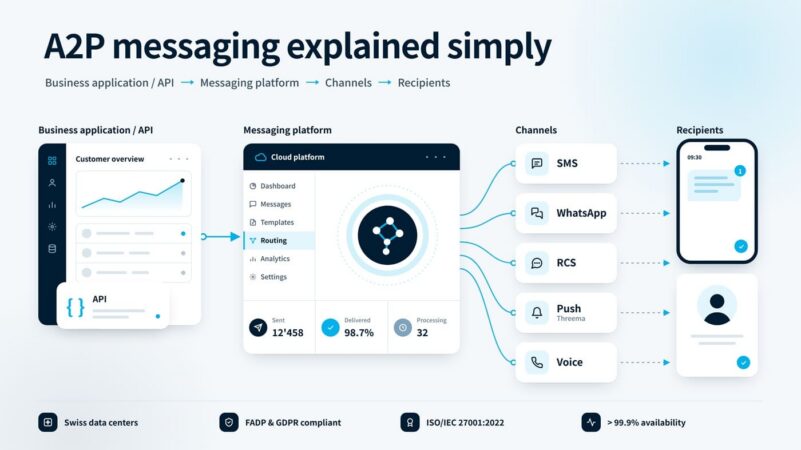
A2P messaging operates via a technical connection (SMS API for businesses) between a business system and a messaging platform.
The process is usually similar:
Application → Messaging Platform → Communication Channel → Recipient
Or more specifically:
CRM, online store, booking system, app, or API → Messaging platform → SMS, WhatsApp, RCS, Push or voice → Customer
Example: Appointment reminder via SMS
A customer books a consultation appointment online.
The booking system saves the appointment and forwards the information to the messaging platform. The platform automatically sends a confirmation immediately after the booking and later a reminder, for example, 24 hours before the appointment.
For the customer, it’s simple: they receive a helpful message in a timely manner.
It’s efficient for the company: The process runs automatically, without any manual effort.
Example: OTP code for login
A user logs in to an online portal.
The system detects the login attempt and generates a one-time security code. This code is sent to the user via an SMS API or a messaging platform. The login is not completed until the code is entered.
This is how A2P messaging supports secure digital processes.
What is A2P SMS?
A2P SMS is one of the best-known forms of A2P messaging. In this process, a company sends automated SMS messages from a system to individuals, for example via a professional SMS gateway.
A2P SMS is frequently used because SMS offers very broad reach. An SMS can be received on nearly any cell phone and does not require an additional app.
Typical use cases for A2P SMS include:
- OTP SMS
- Two-factor authentication
- Appointment reminders via SMS
- Delivery status
- Payment confirmation
- Alerts
- Fault report
- Customer Notification
- Corporate Communication via SMS
A2P SMS is particularly well-suited when a message needs to be short, important, and delivered promptly.
A2P messaging is more than just SMS
Although SMS remains an important channel, modern A2P messaging now encompasses a much wider range of communication channels.
Depending on the use case, companies can use different channels or combine multiple channels.
SMS
SMS is particularly well-suited for short, time-sensitive, and widely accessible messages.
Typical examples:
- Security codes
- Appointment reminders
- Alerts
- Delivery information
- Status updates
WhatsApp Business API
The WhatsApp Business API is designed for businesses to facilitate professional customer communication via WhatsApp. Companies can use it to send service updates, reminders, notifications, and even opt-in marketing communications.
Typical examples:
- Appointment confirmation
- Shipping update
- Customer service message
- Support inquiry
- WhatsApp newsletter with opt-in
RCS Messaging
RCS Messaging for businesses stands for Rich Communication Services. This channel enhances traditional messaging with modern features such as images, buttons, branding, and interactive elements on supported devices.
Typical examples:
- Interactive service updates
- Campaigns with calls to action
- Product information
- Booking confirmations
- Rich messaging for mobile customer experiences
Voice
Voice can be used for automated voice messages or text-to-speech calls. This is particularly relevant when messages need to be actively heard.
Typical examples:
- Alerts
- Escalations
- Service disruption notifications
- Emergency communication
- Critical reminders
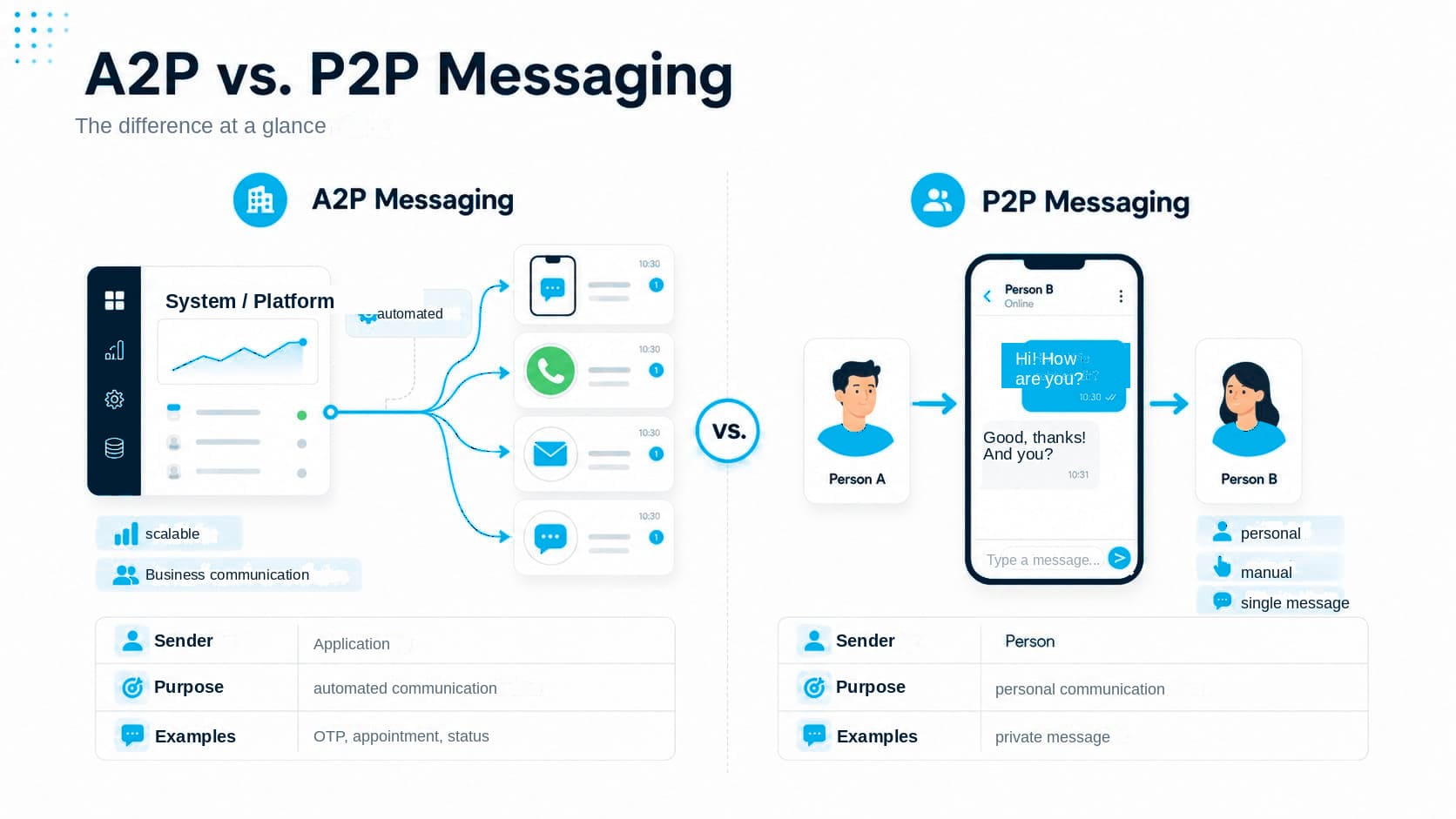
A2P vs. P2P Messaging: What’s the Difference?
A2P messaging and P2P messaging are often confused. The difference is simple.
- P2P messaging stands for person-to-person messaging. One person sends a message to another person.
- A2P messaging stands for application-to-person messaging. An application or business system automatically sends a message to a person.
In short:
P2P is private communication. A2P is automated business communication.
Why do companies use A2P messaging?
Companies use A2P messaging because many communication processes today need to be fast, reliable, and automated.
Customers expect to be informed in a timely manner. At the same time, companies want to reduce manual work and make processes more efficient.
A2P messaging helps achieve both of these goals.
1. Information arrives faster
Many A2P messages are time-sensitive. An OTP code must arrive immediately. An appointment reminder must be delivered before the appointment. A service disruption notice must reach recipients quickly.
A2P messaging helps companies send such messages automatically and in a timely manner.
2. Processes are automated
Without A2P messaging, many messages would have to be created and sent manually. This takes time, is prone to errors, and doesn’t scale well.
With A2P messaging, recurring communication processes can run automatically.
3. Customers Stay Informed
Proactive communication reduces uncertainty. When customers receive a confirmation, reminder, or status update in a timely manner, they are less likely to have to follow up.
This improves the customer experience and reduces the workload on customer service.
4. Security is enhanced
A2P messaging is frequently used for security processes. OTP SMS, two-factor authentication, and alerts help better protect logins, transactions, and accounts.
5. Communication becomes more measurable
Depending on the channel, companies can analyze delivery status, error messages, replies, clicks, or unsubscriptions. This makes customer communication more transparent and easier to optimize.
Typical Examples of A2P Messaging in Everyday Business
A2P messaging is used in many areas of business. The following examples illustrate just how versatile its application is.
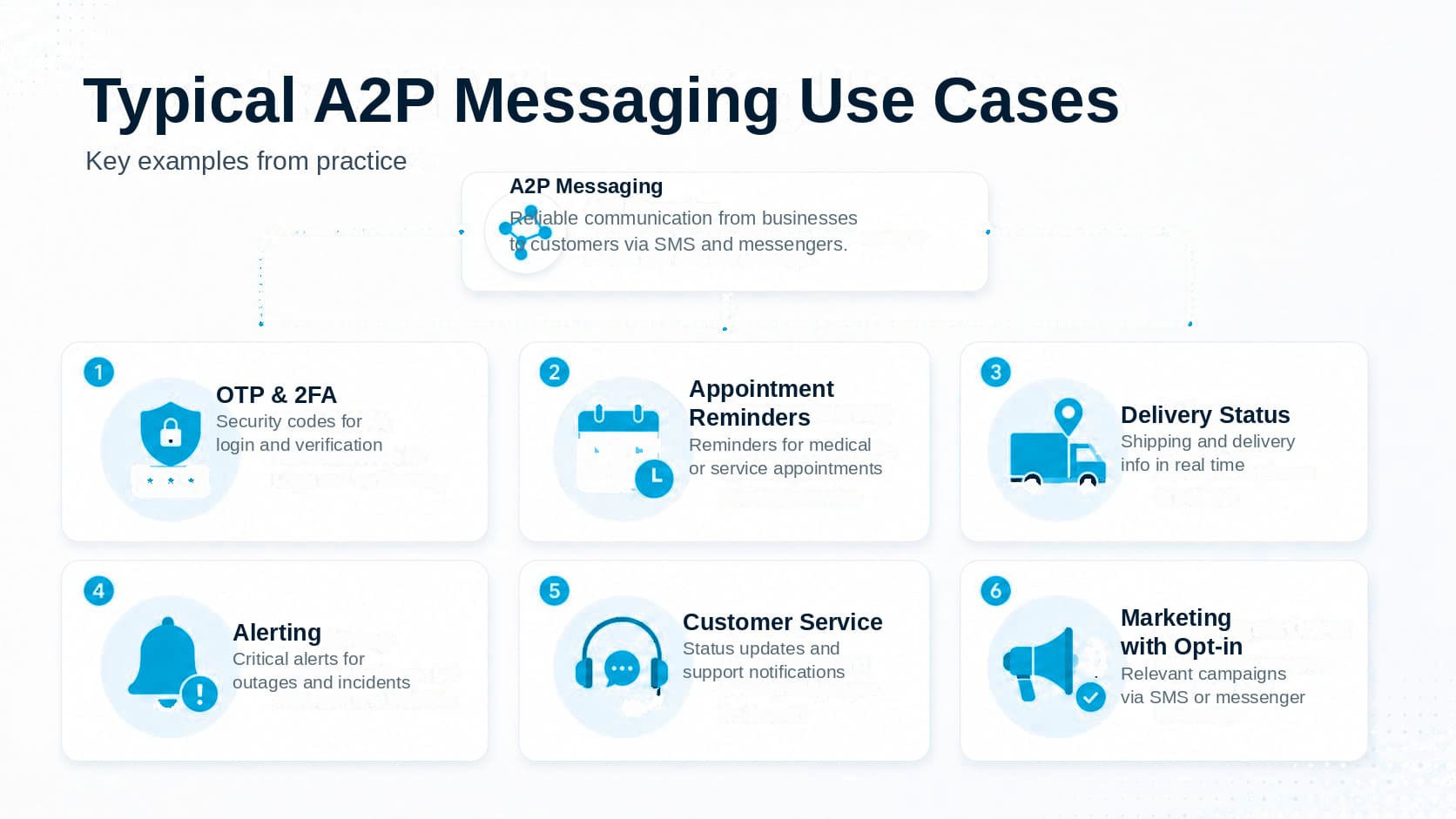
Typical use cases for A2P messages are illustrated, including OTP and 2FA, appointments, delivery status, notifications, customer service, and SMS marketing.
OTP and Two-Factor Authentication
With two-factor authentication via SMS, users receive an additional code. This code confirms that the person has access to the registered mobile phone.
Typical use cases:
- Logging into a customer portal
- Online banking
- Resetting a password
- Verifying a phone number
- Confirm a transaction
- Activate account
A2P messaging is particularly important here because security codes must be delivered quickly and reliably.
Appointment Reminders
Appointment reminders help businesses reduce no-shows and missed appointments.
Typical industries:
- Medical practices
- Hospitals
- Government agencies
- Consulting firms
- Workshops
- Beauty and health service providers
- Educational institutions
- Service organizations
An automatic reminder via SMS, WhatsApp, or RCS can be sent a few days or hours before the appointment.
Delivery and Shipping Status
In e-commerce and logistics, status updates are a key part of the customer experience.
Typical messages:
- Order Received
- Package shipped
- Delivery scheduled for today
- Ready for pickup
- Delivery time changed
- Delivery attempt failed
- Return received
Messages like these reduce follow-up inquiries and create transparency.
Payment and booking confirmations
After making a payment or booking, customers want to know if everything went through successfully.
Typical messages:
- Payment received
- Booking confirmed
- Reservation Received
- Ticket available
- Invoice sent
- Subscription activated
These automated confirmations build trust and provide reassurance.
Alerts and error messages
A2P messaging is also suitable for critical communications.
Typical use cases:
- IT outages
- System failures
- Maintenance windows
- Production issues
- Security incidents
- Escalations
- Emergency communication
In situations like these, messages must be delivered quickly, clearly, and reliably.
Customer Service Notifications
Many support requests arise because customers don’t know the current status. Automated notifications can help reduce this.
Typical messages:
- Request Received
- Ticket being processed
- Feedback required
- Service call scheduled
- Case closed
- Document missing
A2P messaging thus supports proactive customer service.
Marketing communications with opt-in
Marketing can also be conducted via A2P messaging, provided there is a valid opt-in and opt-out processes are properly implemented.
Typical examples:
- SMS marketing
- WhatsApp newsletters
- Promotions
- Coupons
- Event invitations
- New Products
- Customer Loyalty Programs
It is important that marketing messages are relevant, welcome, and legally compliant.
For which industries is A2P messaging particularly relevant?
A2P messaging is of interest to nearly all companies that regularly communicate with customers, users, or employees.
It is particularly relevant for the following industries:
Healthcare
Medical practices, clinics, laboratories, and healthcare providers use A2P messaging for appointment reminders, patient information, organizational notices, and last-minute changes.
Banks and Insurance Companies
Banks and insurance companies use A2P messaging for OTPs, 2FA, transaction confirmations, security alerts, claims status updates, and service information.
Retail and E-Commerce
Retailers and online stores inform customers about orders, deliveries, pickups, returns, and promotions.
Public Administration
Government agencies, municipalities, and public institutions use A2P messaging for appointment confirmations, deadline reminders, public information, and emergency communications.
Logistics and Transportation
Logistics companies and transportation providers send shipping notifications, delivery information, delay notifications, and operational updates.
IT and SaaS
IT service providers and SaaS providers use A2P messaging for account activations, password resets, 2FA, system status updates, and onboarding processes.
Education
Schools, colleges, and continuing education providers use automated messages for course reminders, schedule changes, exam notices, and participant information.
Service Companies
Consulting firms, agencies, service companies, repair shops, and other service providers can use A2P messaging for appointments, customer service, feedback, and customer retention.
Why is A2P messaging particularly important in Switzerland?
In Switzerland, digital communication is about more than just speed and efficiency. Companies must also consider trust, data protection, reliability, and multilingual support.
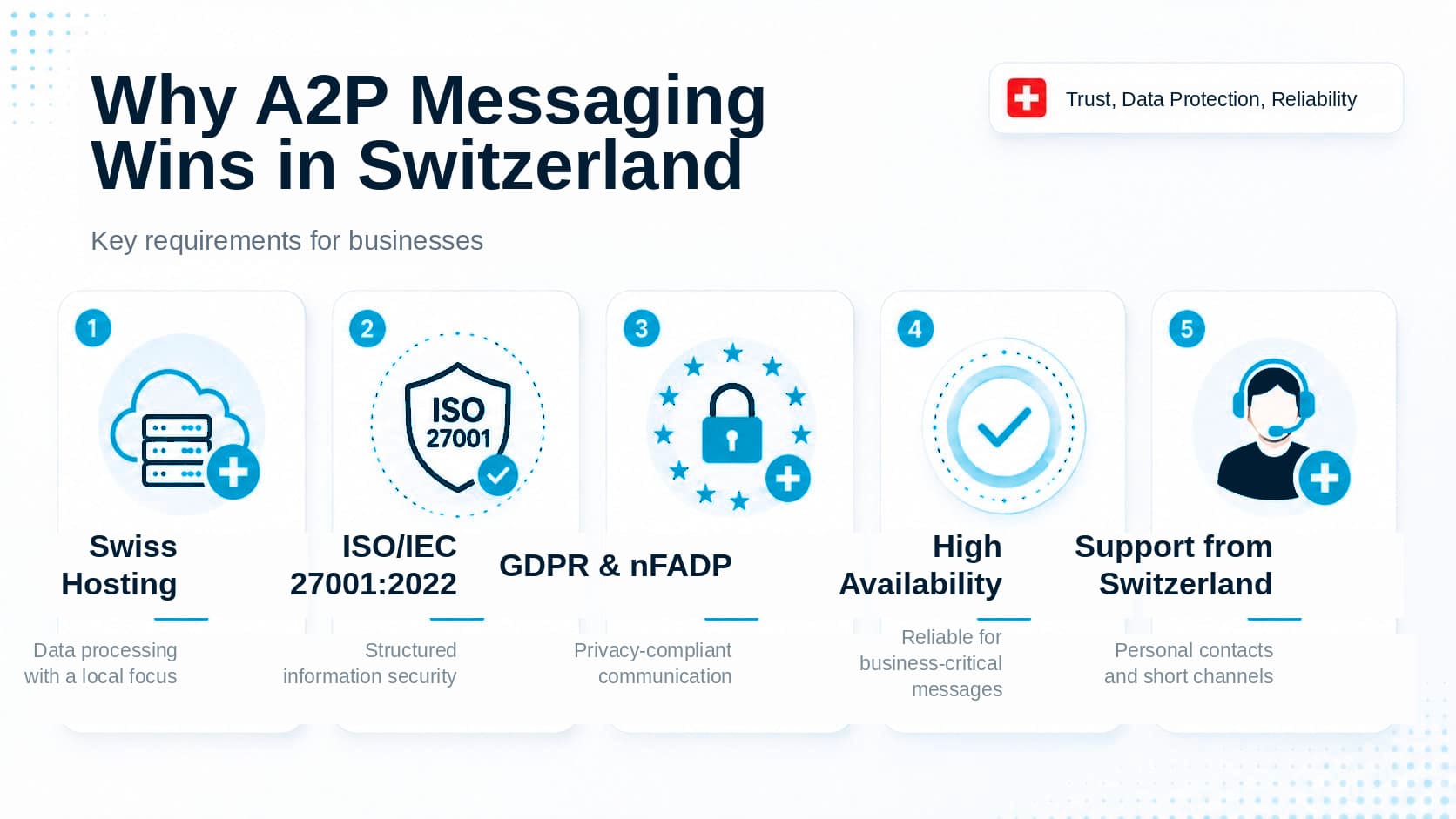
Data Protection and Compliance
A2P messaging often processes personal data. This includes phone numbers, email addresses, customer numbers, appointment details, security codes, and status information.
Therefore, companies must ensure that their messaging processes are designed to comply with data protection regulations. Of particular relevance are the Swiss Data Protection Act (nDSG) and, depending on the nature of data processing, the GDPR as well.
Swiss Hosting
For many companies, the location where data is processed and stored is important. Swiss hosting can be a strong selling point, especially for regulated or security-conscious industries.
These include, for example:
- Banks
- Insurance
- Healthcare
- Public administration
- IT and SaaS companies
- Critical service providers
Reliability
A delayed security code, a failed alert, or a missed appointment reminder can have a direct impact on customer processes.
That’s why a professional messaging platform designed for business-critical communication is essential.
Multilingual Support
Swiss companies often communicate in German, French, Italian, and English. A2P messaging should therefore support multilingual messages, templates, and target audience processes.
Personalized Support
Local support is an advantage when it comes to technical integrations, API questions, or business-critical messages. Swiss companies benefit from points of contact who understand the market, data protection, and corporate requirements.
What should companies look for in an A2P messaging solution?
Not every messaging solution is automatically suitable for professional A2P communication.
Companies should pay particular attention to the following points:
- Data protection and nDSG/GDPR-compliant implementation
- Swiss hosting or clear data processing procedures
- Stable SMS API or messaging API
- Comprehensive documentation for IT teams
- High delivery quality
- Scalability for growing message volumes
- Support for multiple channels
- Reporting and delivery status
- Opt-in and opt-out features for marketing
- Security and access controls
- Integration with existing systems
- Personalized support
A2P messaging should not be viewed merely as a technical delivery channel. It is an important component of digital customer communication.
A2P Messaging with eCall Business Messaging
With eCall Business Messaging from F24 Schweiz AG, companies in Switzerland can implement A2P messaging professionally.
The platform supports the automated delivery of messages via various channels such as SMS, WhatsApp Business API, RCS, Push (Threema), voice, and other communication channels. Companies can trigger messages via API, web portal, or integrations, thereby automating existing communication processes.
Typical use cases for eCall Business Messaging include:
- OTP SMS and two-factor authentication
- Appointment reminders
- Delivery and status notifications
- Customer service notifications
- Alerts and service disruption notifications
- Opt-in marketing communications
- Omnichannel customer communication
Key Trust Factors:
- Swiss provider
- Swiss hosting
- ISO/IEC 27001:2022 certified
- GDPR- and nDSG-compliant communication
- High availability
- Personalized support from Switzerland
- Suitable for SMEs and larger companies
If you want to do more than just send A2P messages technically if you want to operate them securely, scalably, and professionally a specialized business messaging platform is the right approach.
Conclusion: A2P messaging connects systems with people
A2P messaging is a central component of modern corporate communication. It ensures that information from systems automatically reaches the right people quickly, directly, and via the appropriate channel.
Whether it’s OTP SMS, appointment reminders, delivery status updates, booking confirmations, alerts, or customer service messages: A2P messaging helps companies automate communication while improving the customer experience.
For Swiss companies, data protection, hosting, reliability, multilingual support, and personalized assistance are particularly important.
Would you like to implement A2P Messaging professionally in your company?
Discuss your specific use case with our team.

Florian Frei
Florian Frei is Senior Marketing Manager for eCall Business Messaging at F24 Schweiz AG. He is responsible for positioning and marketing the Swiss business messaging platform and focuses on how companies can automate their digital communications securely, reliably and efficiently. His areas of expertise include business SMS, SMS gateways and APIs, A2P messaging, CPaaS, WhatsApp Business, RCS, omnichannel communications, data protection and data hosting in Switzerland. In his expert articles, he provides practical guidance on integrating modern messaging solutions effectively into customer service, marketing and operational processes.Business, two-factor authentication, data protection and digital customer communication for companies.
FAQ: Frequently Asked Questions About A2P Messaging
A2P messaging stands for Application-to-Person messaging and refers to the automated sending of messages from an application, platform, or enterprise system to a person.
A2P stands for Application-to-Person. The term describes communication sent from an application or software to a person.
A2P SMS is the automated sending of SMS messages from a business system to individuals. Examples include OTP SMS, appointment reminders, delivery status updates, payment confirmations, and alerts.
A2P messaging is sent automatically by applications or companies. P2P messaging is private communication between two individuals.
A2P messaging includes SMS, the WhatsApp Business API, voice, push notifications (Threema), and other digital communication channels.
Companies use A2P messaging to automate customer communication, support security processes, reduce manual work, and inform customers more quickly.
Yes. A2P messaging is particularly well-suited for OTP and two-factor authentication because security codes can be sent to users automatically and quickly.
Yes – A2P messaging can be implemented in compliance with data protection regulations if data processing, hosting, access controls, consent, and deletion processes are properly regulated.
A2P messaging is used in sectors such as healthcare, banking, insurance, retail, e-commerce, public administration, logistics, education, IT, SaaS, and service companies, among others.
A Swiss provider can offer Swiss hosting, local support, an understanding of nDSG requirements, and an implementation tailored to Swiss companies.